
Government report, two footnotes → markdown
A government report page with footnotes, converted from PDF to markdown by SarvCrawl. The original page, the unedited output and every audit score.
Text PDFText layer, no OCRcrs-nasa-appropriations.pdf
Input · original page
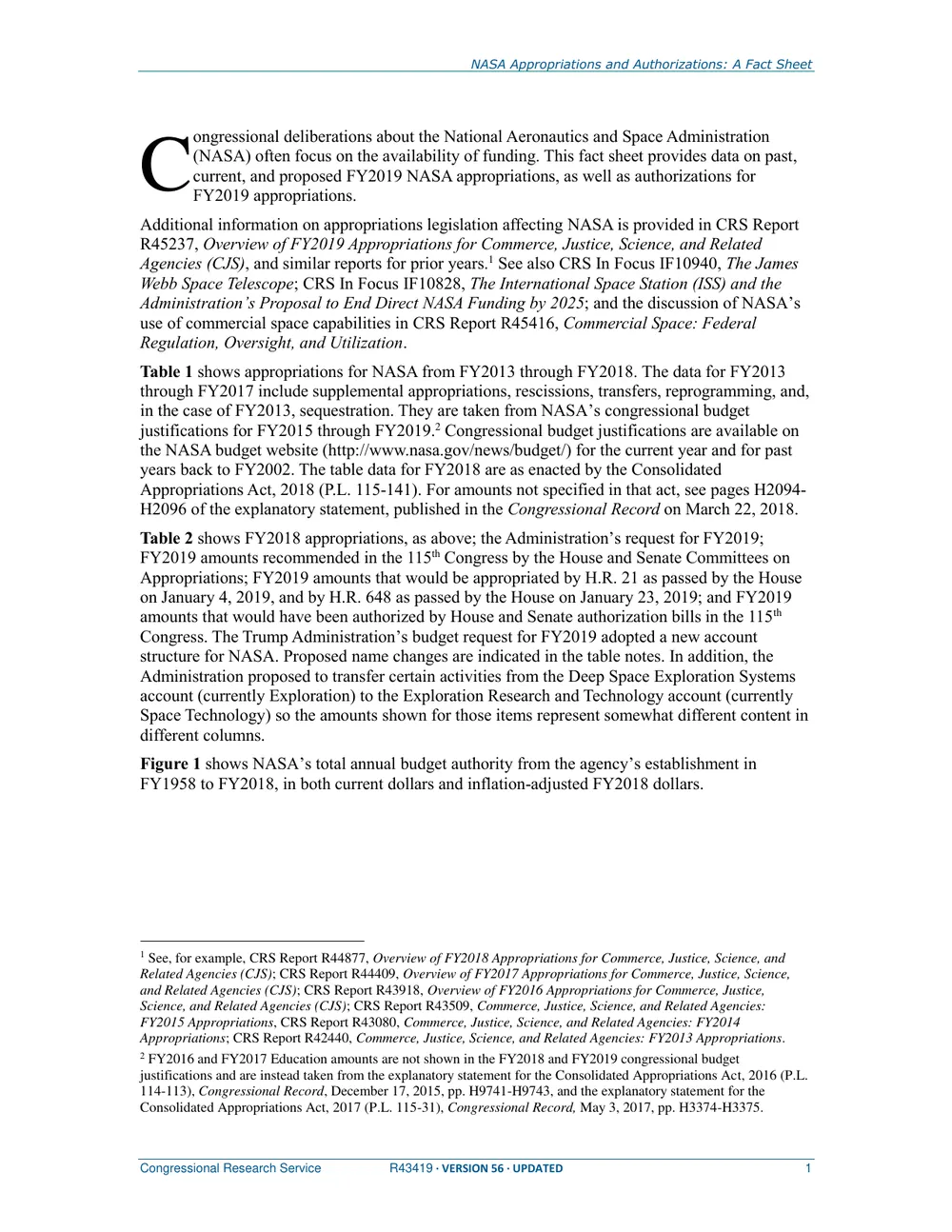 NASA Appropriations and Authorizations: A Fact Sheet, page 2 — Congressional Research Service report R43419, U.S. government work, public domain
Output · markdown, exactly as the API returned it
crs-nasa-appropriations.md
NASA Appropriations and Authorizations: A Fact Sheet
C ongressional deliberations about the National Aeronautics and Space Administration
(NASA) often focus on the availability of funding. This fact sheet provides data on past,
current, and proposed FY2019 NASA appropriations, as well as authorizations for
FY2019 appropriations.
Additional information on appropriations legislation affecting NASA is provided in CRS Report
R45237, Overview of FY2019 Appropriations for Commerce, Justice, Science, and Related
Agencies (CJS), and similar reports for prior years.1 See also CRS In Focus IF10940, The James
Webb Space Telescope; CRS In Focus IF10828, The International Space Station (ISS) and the
Administration’s Proposal to End Direct NASA Funding by 2025; and the discussion of NASA’s
use of commercial space capabilities in CRS Report R45416, Commercial Space: Federal
Regulation, Oversight, and Utilization.
Table 1 shows appropriations for NASA from FY2013 through FY2018. The data for FY2013
through FY2017 include supplemental appropriations, rescissions, transfers, reprogramming, and,
in the case of FY2013, sequestration. They are taken from NASA’s congressional budget
justifications for FY2015 through FY2019.2 Congressional budget justifications are available on
the NASA budget website (http://www.nasa.gov/news/budget/) for the current year and for past
years back to FY2002. The table data for FY2018 are as enacted by the Consolidated
Appropriations Act, 2018 (P.L. 115-141). For amounts not specified in that act, see pages H2094-
H2096 of the explanatory statement, published in the Congressional Record on March 22, 2018.
Table 2 shows FY2018 appropriations, as above; the Administration’s request for FY2019;
FY2019 amounts recommended in the 115th Congress by the House and Senate Committees on
Appropriations; FY2019 amounts that would be appropriated by H.R. 21 as passed by the House
on January 4, 2019, and by H.R. 648 as passed by the House on January 23, 2019; and FY2019
amounts that would have been authorized by House and Senate authorization bills in the 115th
Congress. The Trump Administration’s budget request for FY2019 adopted a new account
structure for NASA. Proposed name changes are indicated in the table notes. In addition, the
Administration proposed to transfer certain activities from the Deep Space Exploration Systems
account (currently Exploration) to the Exploration Research and Technology account (currently
Space Technology) so the amounts shown for those items represent somewhat different content in
different columns.
Figure 1 shows NASA’s total annual budget authority from the agency’s establishment in
FY1958 to FY2018, in both current dollars and inflation-adjusted FY2018 dollars.
1 See, for example, CRS Report R44877, Overview of FY2018 Appropriations for Commerce, Justice, Science, and
Related Agencies (CJS); CRS Report R44409, Overview of FY2017 Appropriations for Commerce, Justice, Science,
and Related Agencies (CJS); CRS Report R43918, Overview of FY2016 Appropriations for Commerce, Justice,
Science, and Related Agencies (CJS); CRS Report R43509, Commerce, Justice, Science, and Related Agencies:
FY2015 Appropriations, CRS Report R43080, Commerce, Justice, Science, and Related Agencies: FY2014
Appropriations; CRS Report R42440, Commerce, Justice, Science, and Related Agencies: FY2013 Appropriations.
2 FY2016 and FY2017 Education amounts are not shown in the FY2018 and FY2019 congressional budget
justifications and are instead taken from the explanatory statement for the Consolidated Appropriations Act, 2016 (P.L.
114-113), Congressional Record, December 17, 2015, pp. H9741-H9743, and the explanatory statement for the
Consolidated Appropriations Act, 2017 (P.L. 115-31), Congressional Record, May 3, 2017, pp. H3374-H3375.
Congressional Research Service R43419 · VERSION 56 · UPDATED 1
Conversion audit
Content fidelity
99.8
ML readiness
83
Overall
74ready
Content fidelity
The markdown compared with the text layer inside the PDF: how much of it survived, in what order, at what length.
- ROUGE-1 F1
- 100
- ROUGE-2 F1
- 99.5
- ROUGE-3 F1
- 99.1
- Jaccard
- 100
- Vocabulary coverage
- 100%
- Length fidelity
- 100%
- Tokens in PDF
- 570
- Tokens in markdown
- 570
precision 100 · recall 100
word pairs in order
word triples in order
shared vocabulary
ML readiness
Whether the text is clean enough to chunk and embed: noise, repetition and sentence shape.
- Noise level
- 0%
- Duplicate lines
- 0%
- Lexical diversity
- 39.8
- Named entities
- 90.4%
- Avg sentence
- 34.2words
Structure
Markdown headings, lists, tables and code blocks. A page of plain prose scores low here even when the conversion is exact, which is what pulls the overall below the other scores.
- Headings
- 0
- Bullets
- 0
- Tables
- 0
- Structure score
- 0
What it got right
- Reading order kept, footnotes at the end
- Every word of the text layer present
What it got wrong
- The drop cap splits off its letter: “C ongressional”
- Superscripts flatten: footnote markers read “years.1”
More examples